Record number of Scots stuck on waiting list for CT and MRI scans: RCR responds to latest data
Record number of Scots stuck on waiting list for CT and MRI scans: RCR responds to latest data
On Tuesday 24th February 2026, Public Health Scotland released its latest quarterly data on waiting times for key diagnostic tests in Scotland. The data is a snapshot from 31st December 2025, giving a complete picture of diagnostic test waits in 2025.
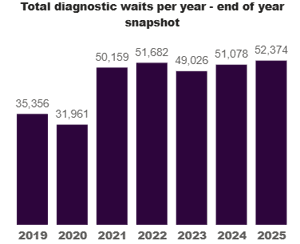
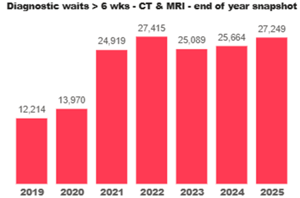
The data show that at the end of 2025, over 52,000 people in Scotland were on the waiting list to have a CT or MRI scan – a record high, and enough people to fill Hampden Park stadium. Over half (27,000) of these had been waiting longer than 6 weeks – a 6% increase compared to the same time the previous year.
Throughout 2025, most patients in Scotland waited more than 6 weeks to have a CT or MRI scan, despite an interim target for 95% of radiology referrals to be seen within 6 weeks by March 2026. The national standard is that no patient should wait longer than 6 weeks for a diagnostic test, including CT and MRI scans.
The total number of people waiting for CT and MRI scans has increased by 64% over the past five years.
Rising demand for complex scans is outstripping the workforce needed to interpret them. In 2025, 430,000 CT and MRI scans were carried out in Scotland – 6% more than in 2024. Over a comparable period, the number of clinical radiologists in Scotland only grew by 3%.
This chart shows the total number of people at the end of each year on the waiting list for a CT or MRI scan in Scotland.
This chart shows the number of people at the end of each year still waiting to have a CT or MRI scan after 6 weeks in Scotland.
Responding to the latest data, Dr Stephen Harden, President of the Royal College of Radiologists (RCR), said:
“Scotland’s long waits for CT and MRI scans are deeply concerning, particularly as these scans are often used to diagnose and monitor serious and urgent conditions, including cancer.
At the current rate, it is difficult to see how Scotland will meet its target for no patient to wait longer than 6 weeks for a diagnostic test.
Unfortunately, delayed scans are often just the first of many hurdles to patients getting answers about their health. Scotland is currently short of 132 radiologists – this represents a shortage of a quarter of the number needed to meet current demand. This means many patients wait too long for their scan results, with a knock-on effect on when treatment can begin. Demand for diagnostics continues to rise, so capacity must increase to prevent further delays impacting patient care.”
Notes to editors
- Media contact: [email protected] 02038054065
- The Royal College of Radiologists (RCR) is the leading professional membership body for clinical radiologists and clinical oncologists
- Clinical radiologists are specialist doctors who use imaging to diagnose, monitor and treat diseases and injuries
- Clinical oncologists are specialist doctors who manage cancer and prescribe radiotherapy and drug-based treatments
- The latest NHS waiting times – diagnostics data released by Public Health Scotland (PHS) shows the number of ongoing waits for eight key diagnostic tests at 31 December 2025 and the lengths of wait experienced so far. These include four endoscopy tests (upper endoscopy, lower endoscopy excl. colonoscopy, colonoscopy, and cystoscopy) and four radiology tests (CT scan, MRI scan, barium studies, and non-obstetric ultrasound).
- The national waiting times standard is that patients should wait no longer than six weeks (42 days) for these diagnostic tests.
- In March 2025, Health Secretary Neil Gray announced an interim target of 95% of referrals to radiology being seen within six weeks by March 2026.
- NHS Scotland's diagnostic activity data (published on 24th Feb) shows a 6% rise in CT and MRI scans carried out over the past year (Apr-Dec 2024 vs Apr-Dec 2025). By comparison, the number of clinical radiologist consultants in Scotland grew by just 3% over the same period, according to NHS Scotland workforce statistics (Sep 2024 to Sep 2025).