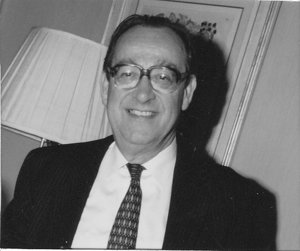
Dr Wilson B James
Dr Wilson B James
Wilson Barrie James was born and educated in Edinburgh and he was called up at the end of WW11, and served in the Royal Navy in the Gulf as a radar technician. He overcame many difficulties to enter and finally graduate in 1954 from Edinburgh University. The resolve and determination he showed in graduating characterised much of his subsequent career. His training in radiology began at the Western Infirmary in Glasgow and progressed to Selly Oak Hospital, Birmingham, where he gained the FFR (latterly FRCR).
24 November 1926 to 15 September 2012
Appointed Consultant at the Southern General Hospital, Glasgow in 1962, he became Consultant in Administrative Charge in 1967. He was elected Fellow RCPS(Gla) in 1973 and served on the College Symposium committee for many years. Recalling his own informal training, one of his first undertakings was to organise a formal teaching programme for trainees in conjunction with the other Glasgow teaching hospitals.
Wilson brought two outstanding attributes to the department. Firstly, he was an inspired manager who thought in detail how the department should function efficiently. His masterstroke was to design in conjunction with physicists an administrative computer system. It immediately solved many problems of registration, film tracking, reports and statistics. This attracted many visitors but he was quick to emphasise that such a system would not cure a poorly organised and managed department.
An excellent clinical radiologist, he initiated weekly X-ray conferences with the major medical and surgical units. A week’s visit to Canada resulted in the introduction of the dictaphone system, where reporting and typing ran concurrently at separate stations. This eliminated the older practice of audio tapes or typists sitting in the reporting room. Another imaginative innovation was to type the cost of the examination on the report thereby emphasising that examinations come at a price!
Secondly, his ability to involve other clinical disciplines resulted in fruitful collaborations. Along with gastroenterologists, dyspepsia was defined and investigated. A great enthusiast for accurate double contrast barium studies, he helped develop and evaluate the chemical and electrical properties of a high density barium suspension for quality examinations. This led to several papers on its clinical application. Similarly, combined studies were carried out with rheumatologists.
Medical physicists were invited to work in the department, where ultrasound and thermographic techniques were developed and evaluated.
He was the author and co-author of over fifty publications, many involving other disciplines. In particular, he encouraged his own junior staff to publish, and many have been thankful for this introduction to the methodology of studies and writing. The Royal College of Radiologists recognised his skills and he served as a Fellowship examiner, and a Member of the Faculty Board and of the Council. In addition, he was Chairman of the Scottish Standing Committee and served on the National Panel of Specialists.
For relaxation, he pursued golf and curling with equal enthusiasm, but with more variable results. At home, he was relaxed and charming, both he and his wife being wonderful hosts, and dispensing hospitality lavishly. Conversation never flagged, and as words struggled to be heard, the clock became an idle bystander.
He is survived by his wife Kate, two daughters and his grandchildren.