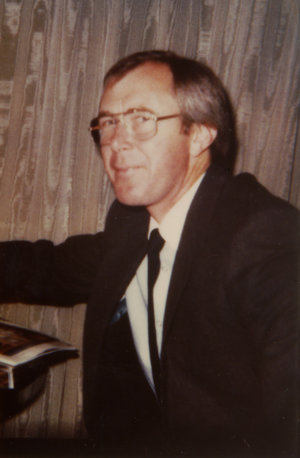
Dr Colin Henry Woodham
Dr Colin Henry Woodham
It was with great sadness that we heard of the death of our Oxford colleague, Dr Colin Woodham, on 23rd November, 2004.
14 June 1942 to 23 November 2004
Colin, who ended his professional career as a Consultant Radiologist to the Oxford Radcliffe Hospitals NHS Trust, based at the John Radcliffe, was considered by his colleagues to be largely a local boy. He was born on 14th June and attended Abingdon School.
In 1970 he decided to change direction and read medicine at St Bartholomew's Hospital, University of London, graduating MB,BS in 1975. He did his preregistration housejobs at the Princess Margaret Hospital, Swindon in 1976/77, followed by Senior House Officer posts at the Royal Berkshire and Battle Hospitals, Reading in 1977/78. He spent his student elective period in radiology at the Radcliffe Infirmary in Oxford, where he was greatly influenced by the late Dr John Hammill, who remained his mentor and until rheumatoid arthritis made life impossible for John Colin became a radiology registrar in Oxford, obtained his FRCR and was rapidly appointed to Consultant Radiologist in 1984.
Colin was always a delightful and hard-working colleague. He had an infectious sense of humour, accompanied by an ascerbic wit, which often left us in stitches. He invented appropriate funny names for both his colleagues and the various examinations which we were called on to perform. For instance, he would refer to radionuclide images as 'confusograms' and the first two letters of Nuclear Medicine were always reversed.
In these days of inevitable super-specialization in radiology, as in all branches of medicine, it is interesting to contemplate that in his prime, Colin could do almost anything. He was as much at home in interventional radiology as he was in the 'new' technique of CT. His lists were correspondingly eclectic.
This ability had an upside and a downside for him. The upside was that we knew that, if there was anything unusual to be done, Colin would do lt. The downside was that this was probably why he was often overworked at the expense of his energy and inroads into his personal time.
One great advantage of his versatility was that. because he could do almost anything, he was able himself to carry out what today is regarded as best imaging practice: taking a patient through the gamut of imaging investigations from the least to the most invasive and balancing this against the swing from the most informative technique to the least. He cared intensely for his patients and always did his best for them. I vividly recall him using the first CT scanner to be installed at the John Radcliffe Hospital at a time when it was administratively not open for business, for the simple reason that Colin regarded this as the only modality which could give him the right answer for that patient at that time. I think experiences of this kind left him with little taste for bureaucracy.
In spite of his excellent scientific background and wide clinical experience, Colin did little formal teaching and his research output was modest.. This was a great pity, because he had so much information to offer and never imparted less than an expert opinion to the students, registrars and colleagues who consulted him or worked with him. Also, he was full of original ideas for both research and audit, but seldom took them to fruition. I don't think the reason for this was too hard to find - he simply had too much clinical work to do.
He leaves his wife, Jean and two sons, Ben and Tom. Ben works in computing, installing databases throughout the world. Tom is in construction. He also leaves two much-loved grandsons, Joe (10) and Alex (5). Jean is a teacher in Oxford.
Colin was charming, universally popular with colleagues and adored by his patients. We will miss him greatly.