NHS spent record £1.4bn on short-term fixes to radiologist shortage in past 5 years
New analysis reveals the UK health service is haemorrhaging money on outsourcing scans to be read by private companies amid a chronic shortage of clinical radiologists, while diagnostic waiting time targets continue to be missed.
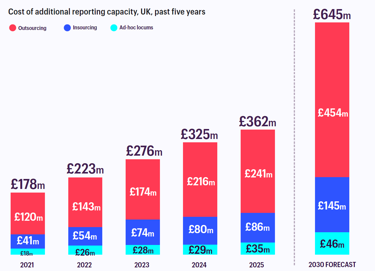
Preliminary data from the Royal College of Radiologists (RCR) 2025 Clinical Radiology Workforce Census report show that in 2025, the UK spent a record £362 million on short-term solutions including outsourcing, paid overtime and locums to manage excess radiology workload. This is enough to pay over 3,000 full-time radiologist salaries. That is more than the UK’s most recently published shortage of almost 2,000 clinical radiologists needed just to meet current demand for diagnostics. Over the last 5 years, the UK has spent £1.4 billion on managing excess radiology workload.
NHS spend on outsourcing scans to private companies soars to record £241 million amid radiologist shortage
Outsourcing scans read by private teleradiology companies accounted for £241 million of the total cost in 2025 – another record high, and a £25 million (12%) increase on 2024. The cost of outsourcing in radiology has doubled since 2021, and is on track to nearly double again, rising to £454 million, by 2030.
Nearly a million scan results delayed despite record outsourcing spend
Despite the UK’s ballooning spend on outsourcing, NHS England data show that in 2025, nearly 1 million (940,900) scan results in England took longer than a month. This is a slight improvement on 2024 (994,633), but a poor performance against the NHS England target that no patient should wait longer than a month for scan results.
Delayed scan results can delay patients getting the diagnosis, appointments, and treatment they need. This can worsen health outcomes – particularly for people with cancer, where every month’s delay to starting treatment can increase the risk of death by around 10%.
The situation is set to worsen as demand for care continues to outpace the rate of workforce growth. In 2024, demand for CT and MRI scans grew by 8%, but the radiology workforce only grew by 4.7%, causing critical diagnostic services to fall further behind.
Serious concerns about quality of outsourced work
NHS radiology leaders are concerned about increasing reliance on outsourcing to fill workforce gaps.
Responding to the RCR 2025 Clinical Radiology Workforce Census, 86% of radiology leaders said they were concerned that outsourcing results in lower quality reports. 90% were concerned that outsourced reports need double-checking by NHS clinical radiologists, adding to their teams’ packed workloads. This clearly does not represent value for money.
Training more radiologists would save the NHS £100 million compared to relying on short-term fixes
Modelling commissioned by the RCR shows that training up just 10% more clinical radiologists per year would, after 10 years, save the NHS £100 million compared to relying on short-term fixes like outsourcing, by creating enough clinical radiologists to make a significant dent in the workforce shortfall.
Radiology training posts are increasingly competitive, with 11 applicants for every post in 2025. So, if more posts were offered, there would be no shortage of resident doctors keen to fill them and train as clinical radiologists.
Dr Stephen Harden, President of the RCR, said:
“Increasing NHS reliance on outsourcing in radiology is not sustainable, and the costs of this are spiralling out of control. In the short term, outsourcing can help to manage diagnostic backlogs, but it cannot be a long-term solution to workforce shortages.
Clinical radiologists play an essential role in making most diagnoses, but rising demand for scans is outstripping our capacity. The single best investment the NHS could make to reduce waiting lists is to train up more clinical radiologists.
To ignore this call and continue to spend more and more on outsourcing would be an irresponsible and short-sighted use of NHS funds, and would not be in patients’ best interests.”
Responding to the RCR 2025 Clinical Radiology Workforce Census, clinical directors of radiology departments provided anonymous testimony about the impact of staff shortages and their experience of outsourcing. They said:
“[Staff shortages result in] heavy reliance on outsourcing - many suboptimal reports needing second reads. Heavy reliance on locum staff, with limited roles.” - radiology clinical director
“Workforce shortages delay report turnaround time, impacting on patient care. Increasingly, the shortfall is met with outsourcing which reduces quality of patient reports and increases pressure on local radiologists for second review.” - radiology clinical director
“[Staff shortages mean] we have to use outsourcing more often. Outsourced reports have many disadvantages over in-house reports, but of particular note they are very expensive.” - radiology clinical director
“There have been escalating costs to the department from using outsourced on-call, external companies.”- radiology clinical director
“Huge spend on outsourcing - with the inevitable impact of increased need for scan reviews, extra unnecessary follow up imaging, reduced quality, and patient safety issues due to [outsourced companies’] lack of knowledge of local patient pathways.” - radiology clinical director
“Despite rising demand, there has been no additional funding to support service delivery. We are now heavily reliant on outsourced reporting, which increases premium spend and has at times led to double reporting, further delaying turnaround times and impacting diagnosis.” - radiology clinical director
“There is a quality concern with some external reports and we need to re report a number of exams.” - radiology clinical director
Notes to editors
Notes to editors:
Media contact: [email protected] +442038054065
The Royal College of Radiologists is the leading professional membership body for clinical radiologists and clinical oncologists.
Clinical radiologists are specialist doctors who use imaging to diagnose, monitor and treat diseases and injuries
Clinical oncologists are specialist doctors who manage cancer and prescribe drug-based treatments and radiotherapy
Preliminary data from the RCR 2025 Clinical Radiology Workforce Census are based on survey responses from 100% of UK clinical directors of radiology departments. It is subject to final checks before the RCR 2025 Clinical Radiology Workforce Census is released in full in summer 2026.
The UK is short of almost 2,000 radiologists (a 29% workforce shortfall) according to the most recently published figures from the RCR 2024 Clinical Radiology Workforce Census
NHS England’s imaging reporting turnaround times priority target is that ‘no verified report should take longer than 4 weeks to be provided after image acquisition, under any circumstance.’